
An Elysium for Rogues
and A Refuge for Scoundrels

While researching the next post in the “The Texas Killer” series, I came across a couple of primary sources that help illustrate the rough society that Texas attracted in the 1830s.
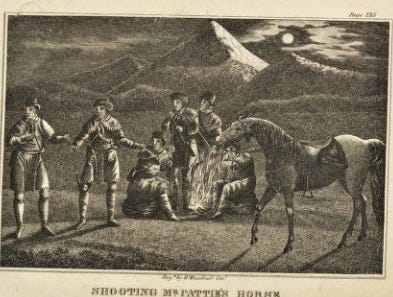
The first is from James O. Pattie (c. 1804-c. 1850), a Kentucky frontiersman that ventured into Texas and the Southwest in the 1820s. This excerpt comes from his 1830 The Personal Narrative of James O. Pattie of Kentucky:
“The fine country of Texas beyond our western frontier, from its peculiar configuration, its vast prairies, its long range of sea coast, and its numerous rivers on the south, and its range of unexplored mountains on the north, and from its peculiar position between the settled countries of the United States on the one hand, and those of the Mexican Republic, beyond the Rio del Norte, on the other, will always be a resort for outlaws, and desperate speculators from our country. Those who wish to get away from their conscience, and those who have visions of paradise in the wild, in short, the moving generation of the country will press to that region to find range. Until the Rio del Norte be our boundary, or a Chinese wall rise between the two states, or a continued line of military posts, interdicting transit, be kept up, it will be the refuge of negro-stealers, and the Elysium of rogues.”
“Elysium of rogues!” What a great phrase. It’s so great that you will see it frequently used to describe Texas in that time period. It did indeed attract a rough class of people. But if you don’t take my word or that of Mr. Pattie, would the testimony of a minister help sway your opinion.
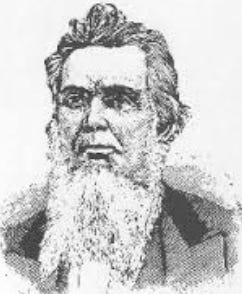
The second passage comes from Z.N. “Wildcat” Morrell. Morrell, originally from South Carolina, came to the “spiritual wilderness” of Texas in 1835, via Tennessee and Mississippi, as a pioneering Baptist preacher. The following passage from his 1872 memoir, Flowers and Fruits from the Wilderness, or Forty-Six Years in Texas and Two Winters in Honduras, captures perfectly the attraction Texas had for a less than respectable class of people, people on the run from something, and outright outlaws.
“Where there is a will there is a way,” is an old adage that is true, provided there is not too much undertaken, and provided, further, that the enterprise is in accordance with the will of God. Two hundred and fifty miles lay between me and the nearest soil of Texas, and it was about five hundred to the “Falls of the Brazos.” But few believed that I could make this journey on horseback, yet a still small voice from Macedonia was heard, and the angel of the vision bid me go forward, saying, “God hath much people in that land.” We pass many things of interest; cross the father of American waters at Rodney, Red River at Alexandria, and reach old “Fort Gaines” on the Sabine, December 21, 1835.
Our company numbered six, and while crossing the Sabine, the ferryman related the following incident, that made a deep impression upon our minds. The river at this crossing was the dividing line between Louisiana and Texas. Only a few days before a man rode up on the Louisiana side, evidently under great excitement, and at the top of his voice ordered the ferryman to bring over the boat. Supposing there was some emergency, the boat was promptly carried to the opposite shore, and the man landed as quick as possible on the Texas side. Just as he was ashore, an officer, with a body of men in pursuit of this refugee from justice, hailed on the eastern bank. The man, recognizing his pursuers, mounted his horse, rode up the hill entirely out of reach, and very deliberately made this short and pointed speech: “Gentlemen, I am just a little too fast for your sort. You have no authority out of the United States. I am entirely safe.” Alighting from his horse and kissing the ground, he continued: “The Sabine River is a greater Saviour than Jesus Christ. He only saves men when they die from going to hell; but this river saves living men from prison.”
We now began to realize the truth of what we had so often heard, that Texas was a place of refuge for scoundrels. Seeing that an impression was made upon our minds, and that all the company remained silent and thoughtful, the jocular ferryman, in order to dispel the cloud of gloom, continued: “And, gentlemen, what have you done that you have come to Texas?” The eyes of the lawyers, the doctor, the deacons, and the preacher, that composed our company, were turned inquiringly towards each other, and while each waited for another to reply, no one answered. After ferriage was paid, we steered our course towards San Augustine.
The conversation now turned on the character of the inhabitants of the country through which we must pass, and a cloud of gloom for the evening hung over our spirits. We at no time would have felt disappointed at meeting robbers and cut-throats at any turn in the road. The evening’s travel, through a poor, piney woods country, brought us to a house, a little more comfortable than we expected to find; but as there was a country store close by, at which we saw a company of suspicious-looking men just before darkness closed in upon us, we spent the first night in Texas in about the same fever of anxiety that we imagine was common with men at that day on their arrival in the State. The family treated us with marked civility, which of itself rendered much relief. Approaching San Augustine, the lands are more valuable, high, and greatly undulating.
On our arrival in the town we received reliable information of the battle, in which the Americans, on the tenth of December, 1835, took possession of San Antonio, after a hard struggle. Col. Milam was among the slain. We learned also that the soldiers were on their way home, after a three months’ campaign.
Nacogdoches was the next town of importance before us. Regrets were expressed by the legal gentlemen that they were in Texas too late to share the honors of war, for which the battle of San Antonio had offered a good opportunity. This is no more than would have been expected from Hayes and Chester, now related by marriage to the “hero of New Orleans.” Some of us, however, desired no such honors, especial!}^ as it would have required the peril of life, and in view of the responsibilities of wives and children behind us. High aspirations were at that early day freely indulged in by men who had acquired in some of the older States the smallest degree of distinction at the bar, or from some petty office. Such men easily worked themselves up to the belief that in this new country, in a very short time, they could become generals or statesmen among a people that they had been taught to believe consisted only of the dregs and renegades from the United States, north and south, as well as from various parts of Europe. Emigrants from Ireland and parts of the United States had settled in Texas as early as 1823; some even before that time.
It is true that just such an element was found in Texas at this time; thrown together in a wilderness country without restraint; mingling with the red men of the forest; roving over these wide-stretching prairies, overshadowed with a mild climate. Flowers bloomed and fruit was growing at almost all seasons of the year. Game of almost every description was so plentiful that it required but little more effort upon the part of man than the animal to obtain a subsistence. All these great blessings could only produce one result upon that class of the population above referred to, and that result was indolence producing a retrograde movement on the intellect of the first immigrants, whose stock of knowledge, it was thought by the aspirants then entering the State, was of small importance at first.”
Thanks for reading. I’ll be back soon with more stories from Texas history.
That was awesome! GTT indeed.