
LOOKING FOR CAMP

More on the Babb family’s experiences and observations will be available soon but I wanted to share something that I discovered while researching. It is a very special series of artworks and poetic sketches by Mary Hallock Foote.
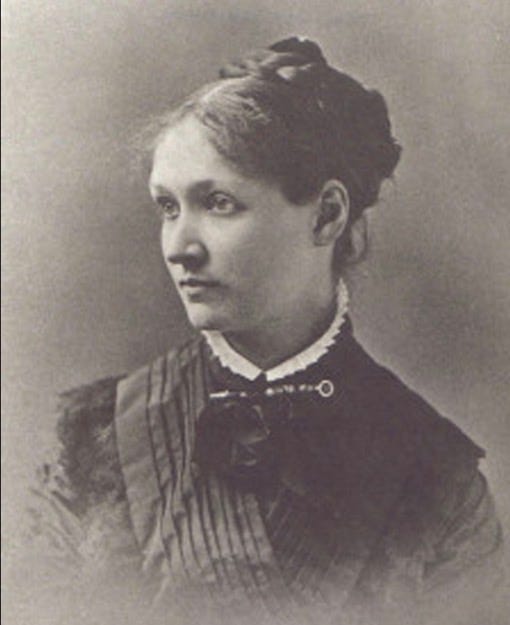
Mary Hallock Foote lived from November 9, 1847 to June 25, 1938 but the power of her genius lives on. She was one of the earliest, if not the earliest, women to write and create art about the West. In his 1972 Pulitzer Prize winning novel, Angle of Repose, Wallace Stegner depended heavily on her life and writing.
The following is the first introduction to a series of art and essays published in 1888 and 1889 titled Pictures of the Far West.
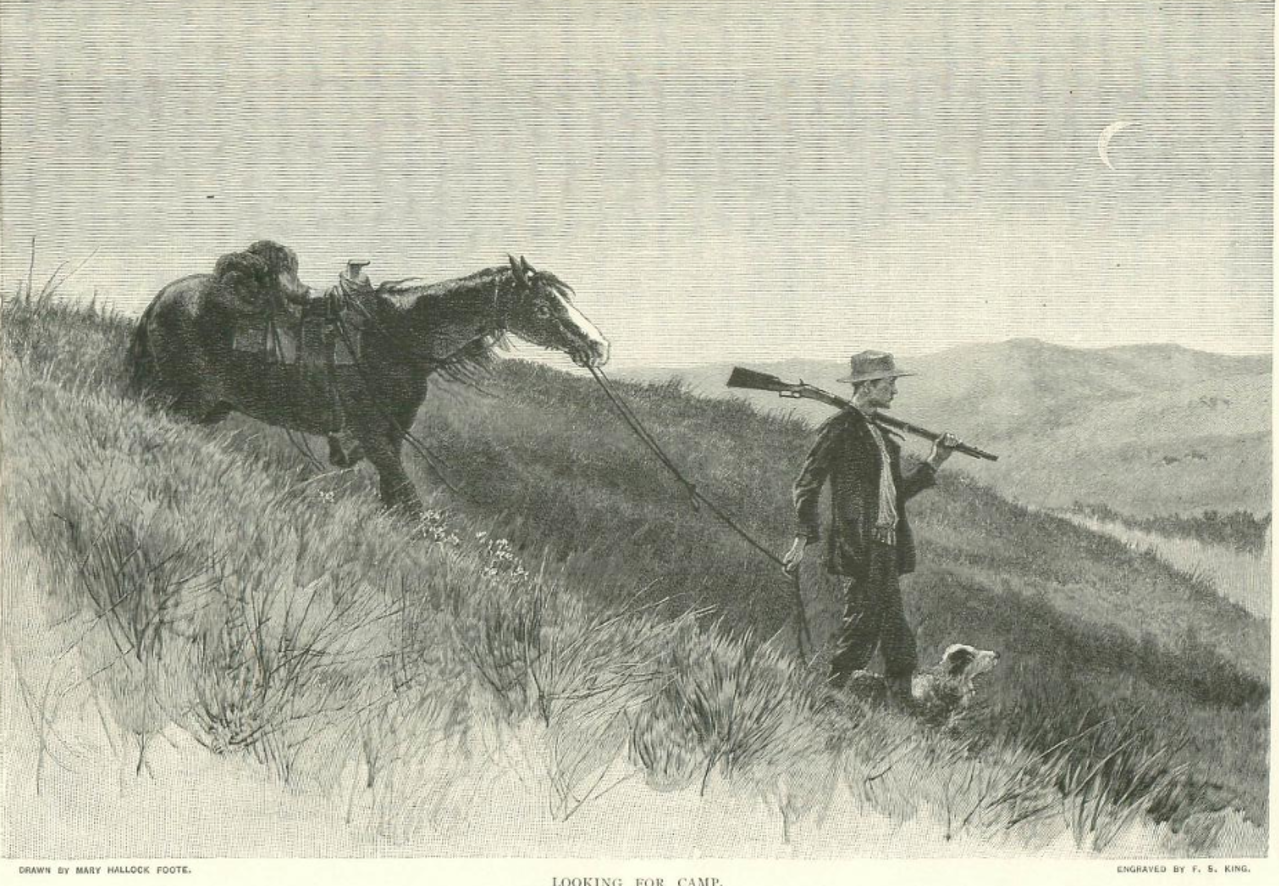
LOOKING FOR CAMP
November 1888
In that portion of the arid belt which lies within the borders of Idaho between the rich irrigated valleys and the mining-camps of the mountains there is a region whereon those who occupy it have never labored — the beautiful “hill-country,” the lap of the mountain-ranges, the free pastures of the plains. Here, without help of hands, are sown and harvested the standing crops of wild grass which constitute the wealth of the cattle-men in the valleys.
Of all the monotonous phases of the Western landscape these high, solitary pastures are the most poetic. Nothing human is suggested by the plains except processions of tired people passing over, tribal movements, war-parties, discoverers, and fortune-seekers. But the sentiment of the hills is restful. Their stillness is not lifeless; it is as if these warm-bosomed slopes were listening, like a mother to her child’s breathing, for sounds from all the shy, wild communities which they feed and shelter— the slow tread of grazing herds, the call of a bird, the rustle of the stiff grass on the hillslopes, the lapsing trickle of water in gulches hidden by willows, and traced by their winding green from far off across the dry slopes.
All the life of the hills tends downwards at night; the cattle, which always graze upwards, go down to the gulches to drink; the hunter makes his camp there when darkness overtakes him. He may travel late over the hills in the twilight, prolonged and colored by the sunset. There is seldom a cloud to vary the slow, deep gradation where the sun has gone down and the dusty valley still smolders in orange and crimson, with a cold substratum of pale blue mist above the river channel. Through a break in the line of the hills, or from a steep rise, one can track the sun from setting to setting till he is gone at last, and the flaming sky colors the opposite hilltops so that they glow even after the rising moon casts shadows. At this hour the stillness is so intense that the faintest breeze can be heard, creeping along the hillslopes and stirring the dry, reed-like grasses with a sound like that of a muted string.
—
Isn’t that wonderful?
Thank you for reading Texas History Lessons. I hope you are doing well.
Another wonderful piece! Her descriptions of the landscape are poetic and just beautiful. It’s as vivid as Mccarthy’s landscapes but with a tranquil, almost musical cadence that is uplifting. Thanks for sharing this!